


I have lied to the people I love. I’ve broken their trust when they needed it most.
Not the kind of lies that make the news. Not always the kind that end relationships, though I’m guilty of that too. What I’m talking about are the small, slow lies. The ones that look like promises when they leave your mouth and dissolve into nothing before you can take them back.
I’ll be there. I’ll do better. I’ll change.
You know the ones. Maybe you’ve said them. Maybe you even meant them. I meant every single one of mine and I broke them, anyway. Not all at once. Not dramatically. Just quietly, the way you let the phone ring one too many times until the other person gives and up stops calling.
This has been on my mind for the past couple of weeks because of a book. A book about a boy who doesn’t break his promise. A boy who keeps it through frozen mountains and violence and terror and exhaustion, who keeps it when any sane person would quit, who keeps it while some of the worst people I’ve ever encountered in any novel are hunting him down like an animal. And I’m sitting here, a grown man who has looked people he loved in the eye and said words he didn’t have the spine to back up.
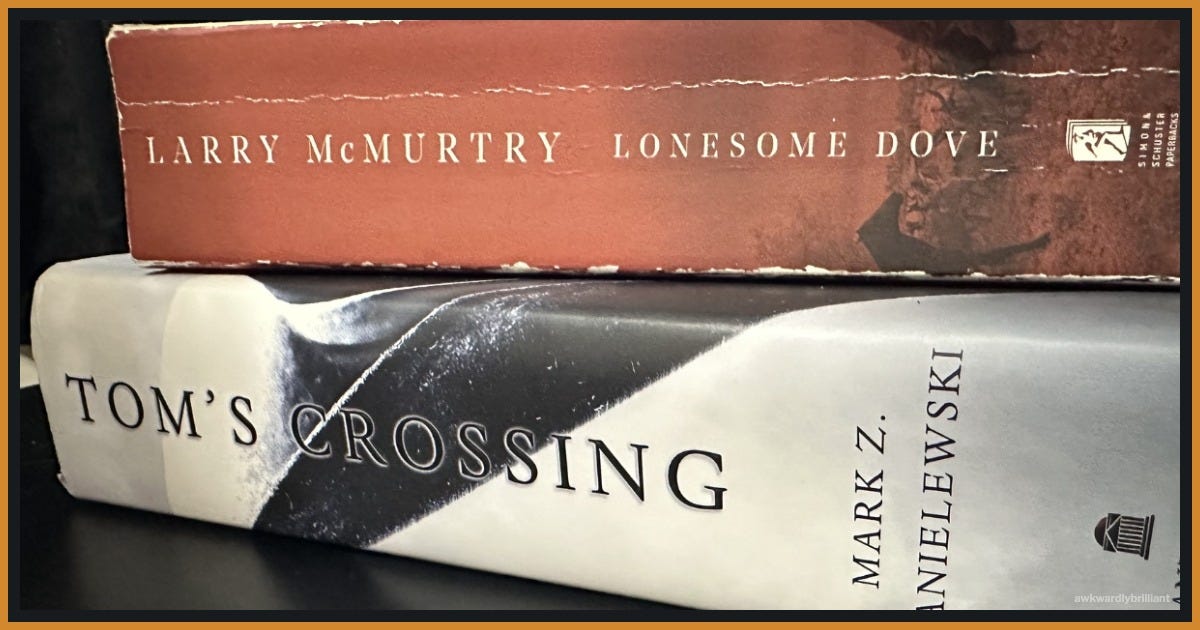
The book is Mark Z. Danielewski’s Tom’s Crossing. It’s 1,232 pages long. I’m about 700 pages in, which means I’m barely past the halfway mark of a book that weighs as much as a small Chihuahua. I read it in bed. I read it at the kitchen table. I read it in the parking lot of the local Albertson’s with the engine off because I can’t put it down, which is something I haven’t said about a book in years.
The novel’s opening line sets the table: “Hard to figure how so much awful horror could’ve started out with just them two horses and not a one yet named…”
Two horses. That’s where it starts.
The story, at its simplest, is about a teenage boy named Kalin March. He’s made a promise to his best friend, Tom, to free two horses that are marked for slaughter. That’s the promise. Free the horses. It sounds like a children’s book when you say it out loud. Two kids, two horses, the mountains of Utah. You could tell this story in a pamphlet.
Except the family that owns those horses is hunting them. And I don’t mean they’re annoyed. I don’t mean they’ve called the sheriff and reported the theft. I mean this might be the most terrifying, relentless, unhinged family I’ve ever encountered in literature, and I’ve read Cormac McCarthy extensively. Kalin isn’t just keeping a promise. He’s keeping a promise while being chased through frozen mountains and ice and rain by people who would do anything to keep their own secret. A secret born in violence and lies.
Danielewski tells it in 1,232 pages.
And I keep thinking about why. Why this story needs that much space. Why this particular promise, between these particular people, requires a book that takes weeks to finish.
I think it’s because a promise kept at great cost can’t be told quickly. The length is the point. You have to feel the weight of it in your hands, in your days, in the way the book rearranges your life around it. You have to carry it the way Kalin carries the promise. You have to be tired of it before you understand it.
I finished another monolithic Western late last year, Lonesome Dove. If you haven’t read it, the short version is this: two old Texas Rangers drive cattle from South Texas to Montana. Along the way, Woodrow Call makes a promise to his best friend, and business partner, Augustus McCrae. The kind of promise you can only make once. One that can cost you everything to keep.
Call keeps it. He drags that promise from Montana back to South Texas. Thousands of miles. Alone. Through weather and country that would kill most men.
People along the way think he’s crazy. He doesn’t argue with them. He just keeps going. And when it’s finally done, when the promise has been kept, Call stands there and says to his friend, “I guess this’ll teach me to be more careful about what I promise people in the future.”
That line wrecked me. Because Call isn’t being careful. He was never going to be careful. He was always going to keep the promise.
The line is the only way a man like that can admit he loved someone without saying the word.
The promise in Tom’s Crossing and the promise in Lonesome Dove are the same. They’re both simple. Free the horses. Bring me home to Texas. A child could understand them. And both of them nearly destroy the people who keep them.
One is an old man who won’t say he loves his best friend. One is a boy who doesn’t need to. And I’m somewhere in between, sitting in a grocery store parking lot, knowing the words and saying none of them.
There’s a smarter version of this essay. One where I break down Danielewski’s prose for you. The Greek mythology threaded through a Western. The sentences that move like hooves on packed dirt before they split open into something that leaves you staring at the ceiling at two in the morning, shaking your head.
And all of that is true and worth talking about. He’s doing something in this book that I haven’t seen anyone do. He’s taken the simplest story, the oldest story, a boy keeping a promise, and he’s given it the space and the seriousness of an epic. He’s saying this small thing deserves twelve hundred pages of your attention. He’s saying you should have to work for it.
But I keep coming back to that promise.
I keep coming back to the question the book is really asking, which is the same question McMurtry asked, which is the same question that’s been sitting in my chest since I was old enough to make a promise I couldn’t keep: How far would you go?
And here’s what gets me. Kalin March isn’t a man. He’s a boy. A boy being chased through mountains by people who want to destroy him, and he doesn’t quit. A grown man with a truck and a rifle and decades of life behind him might talk himself out of it. Might weigh the cost. A boy just goes. Because he said he would. Because his friend asked him to.
Which makes the harder question underneath it even harder: Have you ever loved anyone enough to find out?
I think about my kids. I think about my granddaughter. I think about the promises I’ve made to them, spoken and unspoken.
I’ll be there. I’ll show up. I’ll be the kind of man you can count on.
Mostly, I have been. Mostly.
That word does a lot of heavy lifting in the life of a man who wants to believe he’s dependable. A man who’s mostly there when you need him.
Mostly means I was there for the big things. Mostly means I showed up when it was easy and sometimes when it wasn’t. Mostly means I kept the promises that had audiences and let some of the private ones dissolve.
Mostly is the word you use when you don’t want to say the rest of the sentence out loud.
Nobody writes a 1,232-page novel about a man who mostly kept his promises.
Nobody drags a body on a sign across Texas because they mostly said they would.
The thing about Kalin March, the thing about Woodrow Call, is that neither of them has a “mostly.” They have a promise, and they have their feet, and they have the distance between where they are and where they said they’d be. That’s it. The promise isn’t a feeling. It’s a direction. You walk toward it or you don’t.
I wonder sometimes if the reason I read books like this, if the reason I sat with Lonesome Dove for weeks and am now sitting with Tom’s Crossing for what will probably be a month, is because I’m trying to borrow something.
Like if I can carry the book far enough. Carry it through enough nights and waiting rooms and crowded parking lots and early mornings at the kitchen table. Maybe I’ll absorb some of whatever it is that makes a person capable of that kind of devotion. Maybe I’ll finish the last page and be different. Be someone who doesn’t forget, or ignore, what he said he’d do.
But I don’t think that’s how it works. I think the book knows that’s not how it works.
I think Danielewski knows that most of us are not Kalin March. Most of us, fully grown adults with cars and money and every advantage a boy in the mountains doesn’t have, are the people in the town who hear about what happened and shake our heads and say, I could never do that.
And we’re right. We couldn’t.
But we can read about a kid who could, and that has to count for something, even if I’m not sure exactly what.
Maybe it counts because it keeps the question alive. How far would you go? Maybe you don’t need to answer it. Maybe you just need to keep asking it.
There’s another question the book puts on you, one I haven’t been able to shake. It’s not just about whether you’d keep the promise. It’s about whether anyone has ever looked at you and believed you would. Whether anyone has ever loved you enough to lay that weight on you, to say, I trust you with the thing that matters most to me, and I believe you will carry it.
That’s what Tom does for Kalin. That’s what Gus does for Call.
The promise isn’t just an obligation. It’s an act of faith from the person asking. It says, I know who you are. I know what you’re made of. I’ve watched you, and I believe you’re the one who won’t quit.
I don’t know if anyone has ever looked at me that way.
I don’t know if I’ve given anyone reason to.
And maybe that’s the thing I’m most afraid of, reading this book. Not that I’d fail to keep the promise. But that no one would ever think to ask.
I’m on page 700-something. I’ve got 500 pages to go. The book sits on my nightstand and it’s the last thing I see before I turn the light off and the first thing I see when I open my eyes. I don’t know how it ends. I don’t know if Kalin frees the horses. I don’t know if the promise holds.
But I know I’m going to finish it. I’m going to carry this book the rest of the way, through whatever Danielewski has waiting in those last 500 pages, because I said I would. Because I picked it up, and I made a deal with the story: take me somewhere, and I’ll follow.
It’s a small promise. It’s the only kind I know how to keep right now. And I’m keeping it.